What makes cultures different: the place of emotions in communication

Most of us show some of their feelings with family and close friends. In contrast, whether to show your feelings with people you don’t know or in a work situation is another matter.

It is very easy to recognise if somebody shows their feelings or not. It is one of the most obvious differences to notice between different cultures. Paradoxically, it is one of the hardest to change, to adapt to and to acknowledge.

In some cultures, such as in Northern Europe, you are not expected to show your feelings in work situations. You’ve got to take everything on the chin, bottle up, or not be too enthusiastic when things go well. It can be even more repressed in some Asian cultures.

In many places, showing feelings, particularly such as anger, will make you appear extremely unprofessional.

In contrast, in other cultures such as in Southern Europe, it is considered that feelings are part and parcel of who you are. Feelings are used in decision making. Feelings are used to convey messages that your words cannot. Not exhibiting any feelings is considered as dubious. People will think you may be hiding something, you are cold and unapproachable.

When people from these two different sides meet, it is easy to see that there will be an obvious mismatch. One person might think that they cannot trust the other person because they feel so distant and cold, while the other person might think the other one is like a child, throwing a tantrum or getting excited.

You’d think that when the difference is so obvious to notice, it should be easy to adapt to the situation. This is not the case. If you are on the side of not expressing your feelings, how is it when you force yourself to express them? You are likely feeling like playing a role, not really being you. On the opposite, if you try to repress your feelings, you will likely be like boiling inside.

So, how to make things a bit easier when you communicate with somebody on the other side of the spectrum in terms of expressing feelings?

First, try to move a bit towards the middle of the scale. Try to express yourself slightly more if you usually hide your feelings. Try to be slightly less expressive if you are used to show your feelings plainly.

Second, discuss it openly with your interlocutor. Acknowledge each other’s attitude, do not judge and explain what it means for each of you. Do not interpret somebody’s actions, attitudes and behaviours by your own standards because they just don’t apply to people from other cultures.

What makes cultures different: the level of formality in communication

We all know about that if you compare “Hi mate, what’s up?” with “Good afternoon Professor Martin, I hope it is okay to ask you a question?”, we all recognise that these two expressions demonstrate a different level of formality.

How formal we are when we interact with people is significantly driven by the culture we are in. For instance, especially in countries using English where you do not have a distinction between a formal and more informal way of addressing people – where “you” is used for everybody – things tend to be much more informal. In cultures and societies where in the language you have various forms of formality when you address people, then things tend to be more formal and you have to be a little bit more careful when addressing people.

As an example, in America and in the UK it is quite normal that even people I don’t know just call me by my first name. In contrast, when I was living in Germany and Austria, it was much more likely that people would use a title and my last name to address me when they did not know me. And I had to adapt and do the same as they did in the different countries I lived in. That was the same in France where I grew up, where I would use the polite form and usually the last name to address a person I didn’t know and especially an older person or higher up in the hierarchy.

This is one aspect of formality: it is in the words you use. However, formality or informality express themselves in many more different ways than that.

It is not just about what you say it is also how you say it. For instance, how much eye contact will you make with the person you are interacting with is another aspect of the level of formality. It will be your behaviour too. Will you tend to be a bit closer or more distant physically from the person? How will you be sitting on your chair when talking to that person or standing when you talk?

Formality levels are also expressed for instance in what clothes you wear. Is it OK to have a pair of jeans and a sweater to go see your boss or not?

Being formal or informal seems superficially to be quite an easy aspect of culture to see and to implement. However, as you could see from the above, this formality level will be exhibited in many different aspects of behaviours and communication. So it is actually not as easy as it seems to ensure that you have the right formality level when you communicate with people you do not know and people from different cultures.

And this could lead to potentially serious consequences, like not closing a sale because you haven’t exhibited the correct level of formality. You could easily upset people because you were way too informal compared with what they expected.

What makes cultures different: directness or indirectness in communication

When I began writing my doctorate thesis, I gave what I wrote to my supervisor. Two days later, he said he had read it, handed me the sheets of paper and said “You can put it in the paper bin.” .

Well, that was directness in its purest form.He did not think about the possibility of hurting me with his judgement. Was I hurt? For sure, I wanted more positive feedback but I knew him and how we were direct with one another. I wasn’t hurt, disconcerted maybe.

Had he been of the indirect kind, he probably would have said something like “It was an interesting read, you covered a lot of literature but I would like to make some comments.” The end result would have been the same, me rewriting that piece.

However, the manner of conveying the information would have been completely different. You must have yourself many examples of this kind of situations. So, what characterises the two sides of this communication continuum?

In short, being direct is calling a cat a cat. When you are direct, you say things as you see them.You talk to the point, without wrapping your words in what you consider unnecessary considerations. In contrast, being indirect is being careful about what you say and how you say it.

What makes a culture more direct or indirect is related to the separation put between an individual and her/his thoughts and actions. In direct cultures, when somebody says “It is rubbish” , other direct people understand that it is a judgement of the idea or action, not of the person. In contrast, somebody from a more indirect culture is more likely to take it personally. Indirect cultures are about not losing face.So, people in indirect cultures will speak in a way that always gives credit to others, a way that cannot be understood as a criticism.

We all have a preference towards directness or indirectness. At the same time, most of us are able to use both styles of communication. Do you really speak to your boss and your kids in the same way?

So, when you move to a new culture, a new country, observe carefully what style people usually use and be conscious and aware of using this style when interacting with people. You will avoid upsets for everyone and make communicating a lot more positive experience.

What makes cultures different: an introduction

In this new series of posts, I will explain where the main differences are when it comes to culture. It is based on research in cultural differences and focuses on our relationships and how they differ in various cultures.

Research has categorised the interactions we have with everything around us into four main categories: others, activities, time and environment.

Most of us will have trouble with one of them at a time at some point in our life. You may have problems with a relationship. You may be doing things you do not like and want to change, or you may feel overwhelmed with not enough time in your hands. You may feel disconnected from the world around you.

In contrast, when you are an expat, you are confronted with drastic changes in all these four areas. No wonder the transition is so difficult. Being in a different culture requires to adapt all interactions at the same time.

In these posts, I will discuss the different components of each category so that you understand what they are and how you can use them to perform better in a different culture.

Cultures and people differ widely on how they relate to the four categories of others, activities, time and environment. For instance, when communicating, directness, formality or the use of non verbal communication will be different. People will have different relationships with the past, present and future. They will see time differently, more sequential or more cyclical. Their relationship with nature can be more about control, harmony or humility. Cultures will be more individualistic or group oriented.

These are examples of traits on which cultures will differ. In the following posts, I will discuss the main categorisation of cultural differences. I will explain for each what it means and how it leads to misunderstanding and inadequacy when people are not aware of each other’s culture and are not able to adapt and integrate, leverage components of other cultures they interact with.

Each aspect of cultural differences is not a discrete entity. We are not one or the other. We are somewhere on a continuum between the two extremes. We also have flexibility to move along the continuum. It is this degree of flexibility that will determine abilities to adapt, integrate and leverage cultural differences.

If at any moment, you personally relate to the inadequacies I describe, contact me. You may be in a state of culture shock, preventing you from performing at your best professionally and personally. My specialty is to help people in such situations.

Culture and neurological levels wrap up

We have now come full circle up the neurological levels. We have seen how each level affects the others, up and down. We have seen how culture shapes each level and defines what we do and who we are much more profoundly than we are usually aware of.

This post is a recap on all that, to put everything succinctly in one place.

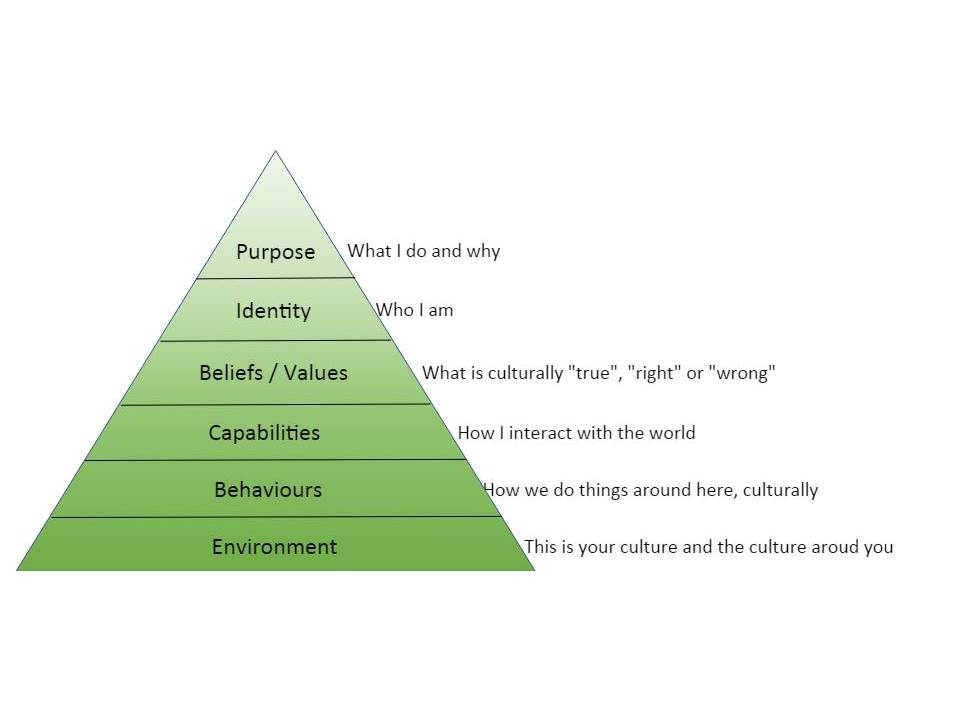
Your environment is where you live, where you work, the places you go to, the people you meet. It is what you read, watch and listen to. It is where you get all the cultural information in the fIrst place from. When you move to a new place, the environment is your point of entry into the new culture.

Behaviours are what you and other people do. It is where the most obvious clash of cultures will happen. It is where the most easily identifiable differences can be observed: what people eat, wear, how they move, they speak, the music they listen to for instance. When you come from a different culture, the behaviours you exhibit will seem strange to others. In the same way, how others behave is likely to baffle you.

Your skills and capabilities define to what extent you will understand and adapt to the new culture. We all have preferences in terms of how we behave and interact and how we expect others to interact with us. At the same time, we also have flexibility to how we can change to deviate from our natural preferences. The flexibility we exhibit is proportionate to our cultural skills and capabilities.

What matters most in terms of cultural understanding and adaptation are the beliefs and values you hold. The stronger we are limited by our beliefs and values and we want to hold on to them, the more difficult it will be to understand and adapt to another culture.

Your identity, that is who you have become to be is actually greatly influenced by your culture. I refer you to a previous post about it. This identity is likely to clash with a new environment, a new culture. It is not a question of ignoring or abandoning your identity when moving to a new culture. However, the experience will allow to grow your identity to become a richer person.

Finally, your purpose in life may be at odd with your new environment. However, I would argue that if you have your true purpose, you should follow it and adapt on the other levels to achieve your purpose, your mission.

So, in all this, where can a coach specialising in cultural diversity help you to achieve a faster transition to your new culture for you to reach your best level in your new surroundings. A coach can help you consider and understand how your new environment affects you and your performance in life. Understand if any arrangements could be adapted.

In terms of behaviours, again, a coach can help you make sense of your and others behaviours. However, only looking at changing behaviours is like covering cracks in a falling wall with wallpaper. It may appear better on the surface but nothing fundamental and long-standing will change.

Working on your skills and capabilities will definitely bring some deeper changes, like filling in the cracks.

However, for achieving a successful transition to your new culture, you will need to understand your beliefs and values and how and where they clash with the new culture, its own values and beliefs.This is like rebuilding the wall. Some of the material will be re-used, in a different way, and new material will come to build a stronger wall.Understanding with the help of a coach how your identity helps or hinders you in the new culture is like checking the foundations on which the wall is built. It may also be necessary to reinforce these foundations.

As you can see, being successful in a new culture requires you to question all your levels of interactions, with yourself and the world around you. No wonder it is not easy and a lot of people have significant problems when moving to a new place. If it is your case, reach out to check how I can help.

Votre mission est-elle également informée par votre culture ?

Nous avons maintenant atteint le dernier étage de la pyramide des niveaux neurologiques. Nous avons commencé avec des facteurs externes tels que l’environnement et les comportements et nous sommes allés plus loin avec des niveaux internes de plus en plus profonds tels que l’identité. Nous nous ouvrons à nouveau vers le monde extérieur avec notre mission.

Vous savez, c’est pourquoi je fais ce que je fais. Le genre de choses qui vous motivent, vous font sortir du lit avec impatience chaque matin. Votre motivation intérieure. Comment vous voulez aider le monde.

Maintenant, on pourrait penser que c’est très personnel, quelque chose qui est encore plus profond que votre identité. Mais est-ce vraiment le cas ? D’où vient votre mission ?

Pensez d’abord à votre mission. Pas si simple. Je sais qu’il y a des choses que je veux faire et être mais je ne pense pas avoir un but plus élevé dans le sens de pourquoi suis-je sur Terre. Le mieux que j’ai trouvé, c’est que je veux aider le monde à se comprendre.

D’où pourrait venir votre mission ? Il n’est pas rare que nous ayons été inspirés par quelqu’un, sur les réseaux sociaux, un livre que nous avons lu par exemple. Quelles sont les chances que cette personne appartienne à votre groupe culturel ? Il y a très peu de personnes dont le message a transcendé les cultures et qui sont reconnues dans le monde entier.

De plus, notre mission est le sens que nous accordons à nos croyances, valeurs et identité. Comment nous les transcendons à un niveau supérieur. Nous avons vu qu’ils sont en grande partie le résultat de notre culture, et notre mission le sera donc aussi.

Cela signifie que lorsque vous changez de culture, vous allez vivre dans un pays différent, même votre mission sera ébranlée et en contradiction avec la nouvelle culture. Imaginez quel genre de crise profonde cela peut déclencher lorsque vous sentez que vous ne pouvez pas atteindre votre mission ! Quoi que vous changiez dans les niveaux inférieurs à ce niveau le plus élevé, les sentiments ne disparaîtront pas. Pour que cela se produise, vous devez travailler sur votre mission. Cela ne veut pas dire ici changer votre mission parce que vous êtes dans une culture différente. Ne changez pas tomber qui vous êtes et ce que vous voulez faire et pourquoi. Mais vous devez développer cette mission, comprendre comment la nouvelle culture dans laquelle vous vivez peut vous aider à devenir une personne plus riche avec une mission encore plus épanouissante.

Is your purpose informed by your culture too?

We have now reached the last step of the neurological levels pyramid. We began with external factors like environment and behaviours and followed up going higher with deeper and deeper, internal levels such as identity. We are now opening up again towards the external world with our purpose.

You know, this is the why I do what I do. The kind of things that drive you, make you get out of bed eagerly every morning. Your inner drive and motivation. How you want to help the world.

Now, you would think that this is highly personal, something that is you, even more than your identity. But is it really? Where does your purpose come from?

First, think of your purpose. Not that easy. I know there are things I want to do and be but I do not feel I have a higher purpose in the sense of what I am on Earth to do. The best I have come up with is that I want to help the world understand each other.

Where might your purpose come from? It is not unusual that we have been inspired by somebody, on social media, a book we read or wherever it was. What are the chances that whoever that person was, it was from amongst your own cultural group? There are very few people whose message has transcended cultures and who are recognised and acknowledged worldwide.

Furthermore, our purpose is the meaning we put on our beliefs, values and identity. How we transcend them to a higher level. We have seen that they are in a very big part the result of our culture, hence our purpose too.

It means that when you change culture, you go live in a different country, even your purpose will be shaken and at odd with the new culture. Imagine what kind of deep crisis this can trigger when you feel that you cannot fulfil your purpose! Whatever you change in the levels below that highest level, the feelings will not disappear. For this to happen, you need to work on your purpose. I do not mean here to change your purpose because you are in a different culture. Do not ditch who are and what you want to do and why. But you need to grow this purpose, understand how the new culture you live in can help you become a richer person with an even more fulfilling purpose.

Votre identité a beaucoup plus d’origines que vous ne le pensez et votre culture en fait partie

Votre identité est qui vous êtes. C’est assez simple, n’est-ce-pas ?

Eh bien, détrompez-vous. Faites une liste de “Je suis …”. Vous vous retrouverez probablement avec une longue liste disparate d’attributs qui définissent votre identité.

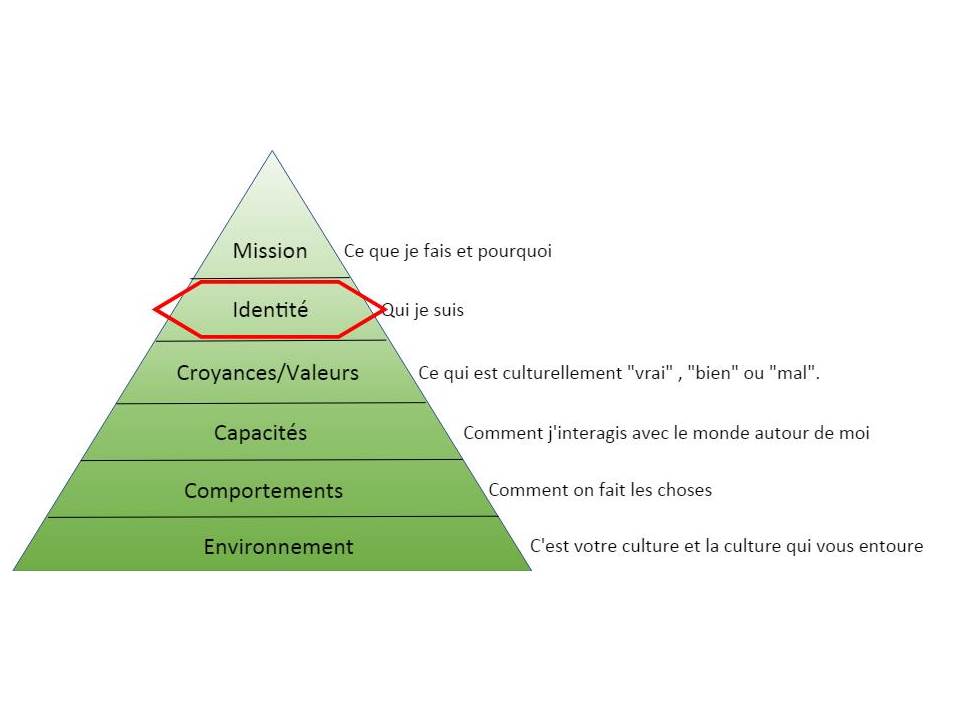
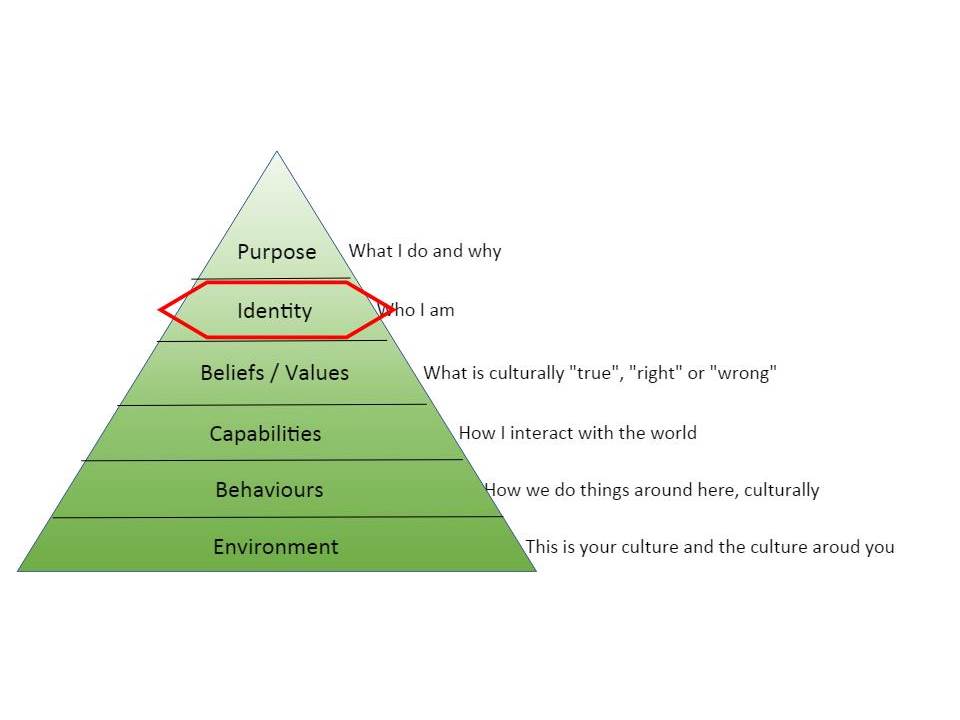
Premièrement, en termes de niveaux neurologiques, une partie de votre identité est ce qui constitue tous les niveaux inférieurs de la pyramide. Vous êtes un mélange complexe de comportements, de capacités, de croyances et de valeurs qui ont façonné qui vous êtes maintenant.

Deuxièmement, vous avez également rencontré ou vu des personnes qui vous ont inspiré par leurs actions ou leurs paroles et vous souhaitez les imiter. Vous avez pris leur message comme élément de votre propre identité.

Comme nous l’avons vu, d’où proviendront ces deux sources ? Oui! De votre culture. Votre identité ne concerne pas seulement vous. Votre identité est la création d’attributs extrinsèques que vous avez adaptés et rendus intrinsèques. Par exemple, vous pouvez provenir d’une famille dans laquelle tout le monde a fait de son mieux pour travailler dur et subvenir aux besoins des autres membres de la famille. Il ne serait pas surprenant dans ce cas que travailler dur fasse partie de votre identité.

Parce que c’est qui nous sommes, notre identité est profondément enracinée. Nous la prenons pour immuable, quelque chose qui EST. C’est notre baromètre interne. Comme un baromètre, sauf si nous le consultons, nous ne sommes pas conscients de la pression atmosphérique. Mais comme un baromètre, nous mesurons la “pression” de notre environnement par rapport à lui.

Encore une fois, dans des environnements et des cultures familières, ce que nous voyons, entendons, ressentons, etc. est généralement aligné sur notre identité. En revanche, entrez dans une culture différente, et c’est un choc. Ce choc est inconscient. Vous n’en êtes pas conscient. Cependant, vous serez plus que conscient des conséquences de l’affrontement. Cela conduira les sentiments du plus profond de vous-même. Si vous vous sentez soudain en colère, frustré, ennuyé, tout ce que vous pouvez imaginer et que vous avez déjà ressenti en vivant dans un pays / une culture différents, il est très probable que vous viviez quelque chose qui est contraire à votre identité.

Si les réunions ont des débuts et des fins lâches et que vous êtes ponctuel et déterminé par le temps, cela vous rendra fou, n’est-ce pas ? Je pourrais donner beaucoup d’exemples comme celui-ci. Vous en aurez probablement beaucoup aussi.

Pour réussir un séjour dans un pays / une culture différents, vous devrez comprendre votre identité et être conscient des écarts avec l’environnement et les comportements que vous vivez. Bien qu’elle soit profondément enracinée, l’identité n’est pas immuable. Pensez-y : Êtes-vous vraiment la même personne qu’il y a 20 ans ? Probablement pas, et c’est parce que votre identité a changé. Elle peut donc changer à nouveau si nécessaire pour assurer le succès de votre expatriation.

Un coach en questions interculturelles vous y aidera. Demandez-moi si vous voulez en savoir plus.

Your identity has many more sources than you think and culture is one of them

Your identity is who you are. That’s pretty easy, isn’t it?

Well, think again. Make a list of “I am …”. You will probably end up with a long and disparate list of attributes that define your identity.

First, in terms of neurological levels, part of your identity is what constitutes all the levels below in the pyramid. You are a complex mixture of behaviours, capabilities and beliefs and values that have shaped who you are now.

Second, you also have met or seen people who have inspired you with their actions or words and you wish to emulate them. You have taken as part of your identity their message.

As we have seen, where will these two sources come from? Yes! From your culture. Your identity does not relate just to you. Your identity is the making of extrinsic attributes that you have adapted and made intrinsic to you. For instance, you may come from a family in which everybody have done their best to work hard and provide for the other members of the family. Well, it would not be surprising that working hard is part of your identity.

Because it is who we are, our identity is extremely deeply ingrained. We take it for immutable, something that IS. It is our internal barometer. Like a barometer, except if we take a reading, we are not aware of the atmopsheric pressure. But like a barometer, we measure the “pressure” of our environment against it.

Once again, in familiar environments and cultures, what we see, hear, feel and so on is usually aligned with our identity. In contrast, step in a different culture, and it is a clash. This clash is unconscious. You are not aware of it. However, you will be more than aware of the consequences of the clash. It will drive feelings from deep down. If you suddenly feel angry, frustrated, annoyed, anything you can imagine and you have ever felt when living in a difference country/culture, then it is very likely that you are experiencing something that is against your identity.

If meetings have loose beginnings and ends and that you are punctual and time-driven, it will drive crazy, won’t it? I could give a lot of examples like this one. You will probably have many too.

To make a stay in a different country/culture successful, you will need to understand your identity and be aware of the gaps with the environment and behaviours you experience. Although it is deeply ingrained, identity is not immutable. Think about it: Are you really the same person as 20 years ago? Probably not, and it is because your identity has shifted. So it can shift again if necessary to make your expatriate stay successful.

A coach in inter-cultural issues will help with this. Just ask if you want to know more.

Vos croyances et valeurs affectent profondément la façon dont vous réagissez à des cultures différentes

Dans cette série d’articles, j’introduis comment la culture est liée aux niveaux neurologiques qui forment chacun de nous.

Nous avons déjà vu l’environnement et comportements. Ces deux niveaux sont les manifestations extérieures de la culture. Le niveau suivant que nous avons étudié, vos capacités, démontre à quel point vous comprenez, vous vous adaptez à et gérez les différentes cultures.

Alors que nous allons plus haut dans la pyramide, nous commençons à toucher des aspects plus profonds, donc moins évidents, de la culture. On suppose souvent qu’il s’agit de caractéristiques individuelles. Ici, je dirai que ces aspects sont également dictés par votre culture.

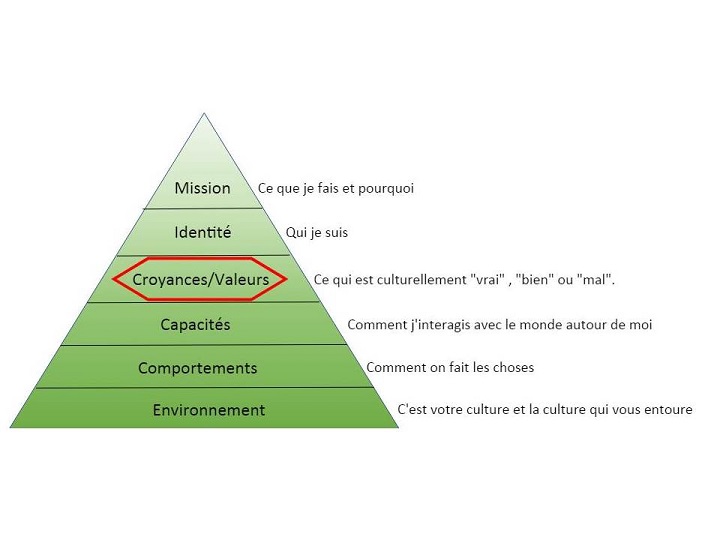
Le prochain niveau que je présenterai dans cet article concerne vos valeurs et vos croyances. Les valeurs sont ce que vous êtes venu à considérer comme bien ou mal. Les croyances sont ce que nous considérons comme vrai ou faux, que ce le soit ou non. Il n’y a rien d’objectif dans les croyances et les valeurs. Elles sont décidées arbitrairement. Elles sont, encore une fois, ce que nous avons appris des autres en grandissant. Nous avons également établi d’autres croyances et valeurs tirées de notre propre expérience.

Vos croyances et vos valeurs auront d’énormes effets sur votre réussite dans une culture différente. Imaginez un instant que l’une de vos valeurs est que votre propre culture est supérieure ou inférieure aux autres. Comment pensez-vous que cela vous affectera lorsque vous arriverez dans une culture différente ? Si vous pensez que vous ne pouvez pas apprendre une langue étrangère, comment pensez-vous que vos interactions se dérouleront dans un autre pays ?

La bonne chose au sujet des croyances et des valeurs arbitraires est que nous pouvons décider de les changer si elles ne sont pas utiles ; si elles nous nuisent. Si vous traitez les cultures comme différentes et non supérieures ou inférieures, vous développerez un esprit plus curieux et ouvert envers la nouvelle culture dans laquelle vous vivez actuellement. Si vous croyez pouvoir apprendre une langue étrangère, vous le ferez très probablement!

Et la capacité de comprendre et d’adapter vos croyances et vos valeurs sera cruciale pour naviguer dans la diversité culturelle. Les croyances et les valeurs sont les filtres à travers lesquels nous interprétons les niveaux inférieurs de comportements, d’environnement et de capacités. Ce sont ces filtres qui créent ensuite les sentiments que nous avons face à un nouvel environnement.

Imaginez que vous venez d’une culture qui valorise l’ancienneté et l’expérience; vous avez été promu, comme tout le monde, en fonction de votre ancienneté. Tout à coup, vous êtes dans une culture qui valorise les réalisations récentes plus que l’ancienneté. Vous aurez probablement l’impression de ne pas obtenir le respect que vous méritez selon vos propres valeurs. Cela vous laissera irrité, agacé, contrarié et ne sera pas propice à des interactions réussies avec vos collègues, patrons et subordonnés.

En revanche, revoir, comprendre et adapter vos valeurs et vos croyances lorsque cela sera nécessaire permettra de changer à leur tour vos capacités, vos comportements et attitude envers votre environnement.