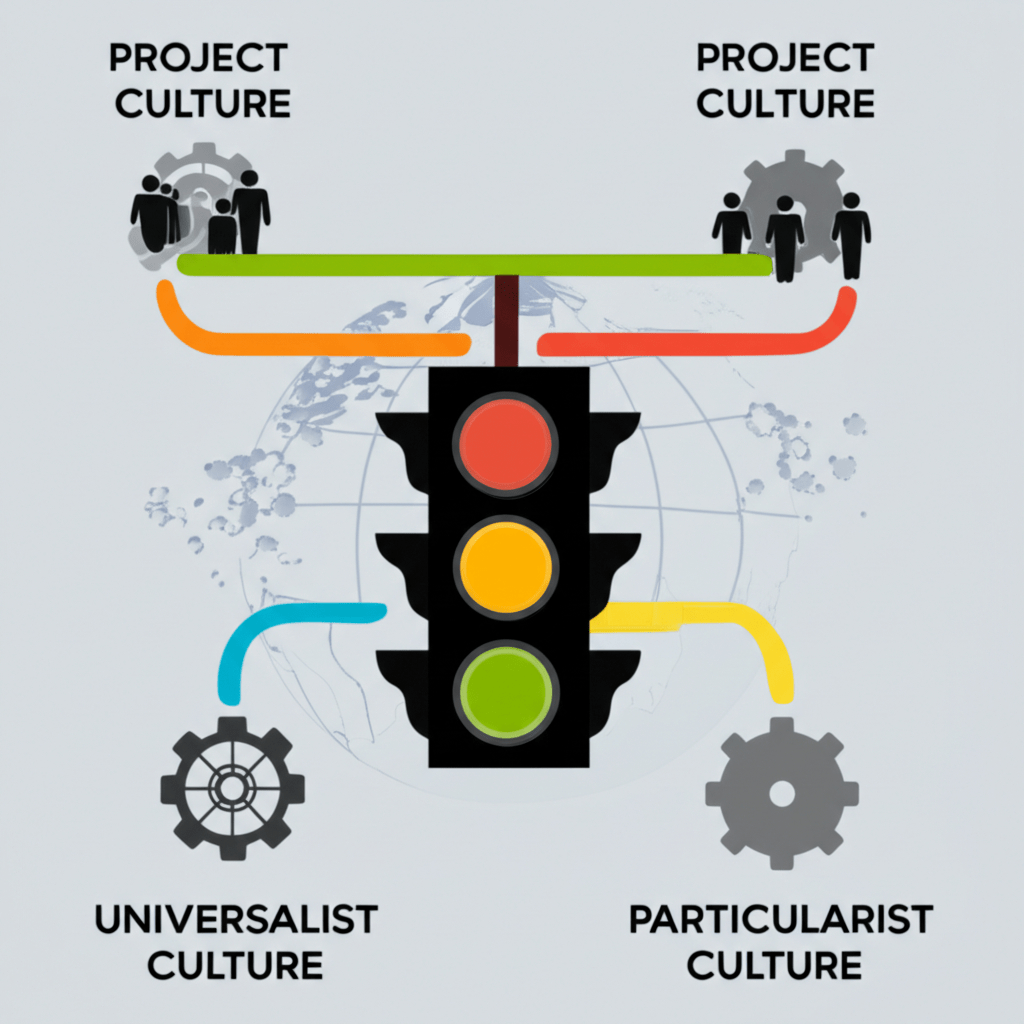
Understanding Fairness in Project Management

This article was originally published at: https://medium.com/@nadegeminois/understanding-fairness-in-project-management-54e6932eb9de

In project management, understanding the cultural nuances of fairness can be pivotal. All societies and cultures have their own set of rules and laws, but the adherence to these can vary significantly.

On one hand, we have universalist cultures, where rules and laws are applied uniformly to everyone. This “one size fits all” approach is straightforward and predictable. On the other hand, particularist cultures adapt the application of rules based on the context of the situation, allowing for flexibility and discretion.

Both approaches aim for fairness, yet the definition of fairness itself varies. In many Western cultures, fairness is often equated with treating everyone the same. However, in other cultures, fairness is seen as context-dependent, where the circumstances dictate the application of rules.

Consider this scenario often used to explore personal and cultural values: Imagine a close friend or family member has broken the law, resulting in harm to someone else, and you are the main witness. Would you uphold the law, potentially leading to punishment for your friend or family member, or would you stand by them? Would your decision change based on the specifics of the situation?

This distinction between universalist and particularist cultures can have significant implications in business, especially for project managers working in multinational environments. For instance, a company might develop a successful employee reward system in one location and decide to implement it globally. However, this approach will only succeed if all locations share the same concept of fairness. Otherwise, the system might be perceived as unfair and could even backfire in offices where cultural norms differ.

So, how can project managers navigate these cultural differences, especially when working in a new country or with a diverse team? First, assess your own cultural preferences. Then, evaluate where your colleagues or stakeholders fall on the universalist-particularist spectrum. Observe whether rules and policies are prominently followed or not. Like waiting for the green light to cross the street. These observations can provide insights into the cultural context.

If there is a gap between your preferences and those of others, adapting your behaviour and actions to align with local expectations is crucial. This can be challenging, as cultural norms often influence our perceptions of right and wrong, good and bad. It’s essential to set aside personal judgments and understand that these concepts are relative rather than absolute.


Time Management Across Cultures: Strategies for Project Managers

This article was originally published at: https://medium.com/@nadegeminois/time-management-across-cultures-strategies-for-project-managers-93b9714025ec

Navigating cultural differences in time perception can be a complex challenge.

Imagine this scenario: a team member arrives 10 minutes late to a crucial meeting. Fifteen minutes into the discussion, she takes a phone call. Her colleague interrupts twice with pressing questions, and now she needs to step out to address another matter. With only 15 minutes remaining, the core agenda remains untouched, leaving you wondering how to proceed.

How would you react in this situation? Would you find it exasperating or simply part of the norm? Your response might depend significantly on your cultural understanding of time.

There are two primary cultural approaches to time: monochronic and polychronic.

In monochronic cultures, time is viewed as a series of tasks to be completed in a linear sequence. Time is about doing. Meetings are expected to start punctually, adhere strictly to the agenda, and participants are focused on the task at hand. Tardiness is typically met with apologies, as time is seen as finite and linear. Cultures such as North America, Northern Europe, and some parts of Asia exemplify this structured and disciplined view of time. In these cultures, time is a resource to be managed carefully, and any deviation from the schedule can be seen as a disruption.

On the other hand, polychronic cultures, such as those found in South America, the Middle East, and Southern Europe, perceive time more fluidly. Here, time is about what you’re doing at the moment rather than adhering strictly to schedules. Priorities shift based on what is deemed important at the time, and time is a tool for building and nurturing relationships. It’s not about multitasking per se, but rather a flexible approach to switching between tasks. What might be seen as distractions in monochronic cultures are simply part of the natural flow in polychronic settings. In these cultures, the emphasis is on human interaction and the quality of relationships, rather than rigid adherence to timeframes.

So, as a project manager, how do you navigate these cultural differences in time perception? Understanding and respecting these cultural nuances is crucial. It involves being adaptable and finding a balance between maintaining project timelines and accommodating the cultural practices of your team members. By fostering open communication and setting clear expectations, you can bridge the gap between different time perceptions and ensure successful project delivery. Embracing cultural diversity in time management can lead to more harmonious and effective teamwork, ultimately driving project success.

Understanding Formality in Project Management Communication

This article was originally published at: https://medium.com/@nadegeminois/understanding-formality-in-project-management-communication-0fe9a8156d45

In the realm of project management, the way we communicate can significantly impact our relationships with stakeholders and team members. Consider the difference between a casual “Hi mate, what’s up?” and a more formal “Good afternoon Professor Martin, I hope it is okay to ask you a question?” These expressions highlight varying levels of formality, which are often influenced by cultural norms.

Cultural Influences on Formality

The level of formality in communication is largely dictated by cultural context. In English-speaking countries, where “you” is universally used, interactions tend to be more informal. Conversely, in cultures with distinct formal and informal address forms, communication is generally more formal, requiring careful consideration of how we address others.

For instance, in the United States and the UK, it’s common for people to address each other by first names, even if they are not acquainted. However, during my time in Germany and Austria, I noticed a preference for using titles and last names in initial interactions. Similarly, in France, where I grew up, it was customary to use the polite form and last name, especially when addressing someone unfamiliar or of higher status.

Beyond Words: The Many Facets of Formality

Formality extends beyond the words we choose. It encompasses how we convey our messages. Eye contact, physical proximity, and body language all play a role in determining the level of formality. For example, how close you stand to someone or how you sit during a conversation can signal your level of formality.

Even attire can reflect formality. Is it appropriate to wear jeans and a sweater when meeting with your boss? These considerations are crucial in maintaining the right level of formality in professional settings.

The Complexity of Formality in Communication

While formality might seem straightforward, it manifests in various aspects of behaviour and communication. Ensuring the appropriate level of formality, especially when interacting with unfamiliar individuals or those from different cultures, can be challenging.

Failing to match the expected formality level can have serious repercussions. It might result in losing the trust of a stakeholder. As project managers, understanding and adapting to these nuances is essential for successful stakeholder engagement and project delivery.

What makes cultures different: an introduction

In this new series of posts, I will explain where the main differences are when it comes to culture. It is based on research in cultural differences and focuses on our relationships and how they differ in various cultures.

Research has categorised the interactions we have with everything around us into four main categories: others, activities, time and environment.

Most of us will have trouble with one of them at a time at some point in our life. You may have problems with a relationship. You may be doing things you do not like and want to change, or you may feel overwhelmed with not enough time in your hands. You may feel disconnected from the world around you.

In contrast, when you are an expat, you are confronted with drastic changes in all these four areas. No wonder the transition is so difficult. Being in a different culture requires to adapt all interactions at the same time.

In these posts, I will discuss the different components of each category so that you understand what they are and how you can use them to perform better in a different culture.

Cultures and people differ widely on how they relate to the four categories of others, activities, time and environment. For instance, when communicating, directness, formality or the use of non verbal communication will be different. People will have different relationships with the past, present and future. They will see time differently, more sequential or more cyclical. Their relationship with nature can be more about control, harmony or humility. Cultures will be more individualistic or group oriented.

These are examples of traits on which cultures will differ. In the following posts, I will discuss the main categorisation of cultural differences. I will explain for each what it means and how it leads to misunderstanding and inadequacy when people are not aware of each other’s culture and are not able to adapt and integrate, leverage components of other cultures they interact with.

Each aspect of cultural differences is not a discrete entity. We are not one or the other. We are somewhere on a continuum between the two extremes. We also have flexibility to move along the continuum. It is this degree of flexibility that will determine abilities to adapt, integrate and leverage cultural differences.

If at any moment, you personally relate to the inadequacies I describe, contact me. You may be in a state of culture shock, preventing you from performing at your best professionally and personally. My specialty is to help people in such situations.

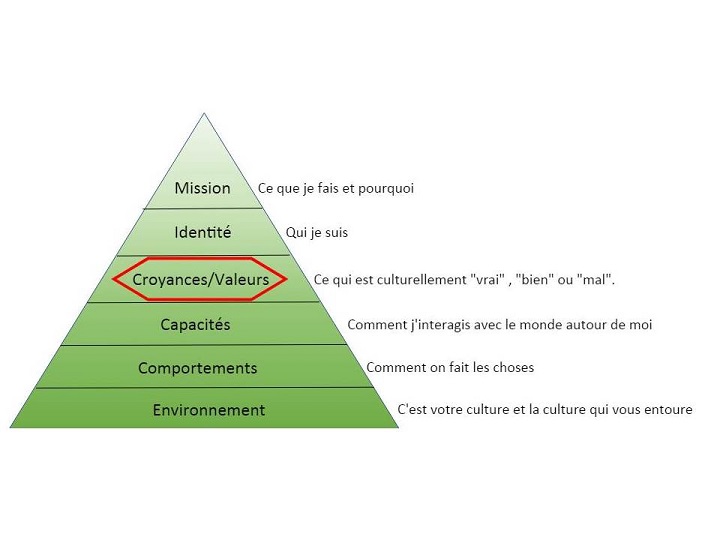
Vos croyances et valeurs affectent profondément la façon dont vous réagissez à des cultures différentes

Dans cette série d’articles, j’introduis comment la culture est liée aux niveaux neurologiques qui forment chacun de nous.

Nous avons déjà vu l’environnement et comportements. Ces deux niveaux sont les manifestations extérieures de la culture. Le niveau suivant que nous avons étudié, vos capacités, démontre à quel point vous comprenez, vous vous adaptez à et gérez les différentes cultures.

Alors que nous allons plus haut dans la pyramide, nous commençons à toucher des aspects plus profonds, donc moins évidents, de la culture. On suppose souvent qu’il s’agit de caractéristiques individuelles. Ici, je dirai que ces aspects sont également dictés par votre culture.

Le prochain niveau que je présenterai dans cet article concerne vos valeurs et vos croyances. Les valeurs sont ce que vous êtes venu à considérer comme bien ou mal. Les croyances sont ce que nous considérons comme vrai ou faux, que ce le soit ou non. Il n’y a rien d’objectif dans les croyances et les valeurs. Elles sont décidées arbitrairement. Elles sont, encore une fois, ce que nous avons appris des autres en grandissant. Nous avons également établi d’autres croyances et valeurs tirées de notre propre expérience.

Vos croyances et vos valeurs auront d’énormes effets sur votre réussite dans une culture différente. Imaginez un instant que l’une de vos valeurs est que votre propre culture est supérieure ou inférieure aux autres. Comment pensez-vous que cela vous affectera lorsque vous arriverez dans une culture différente ? Si vous pensez que vous ne pouvez pas apprendre une langue étrangère, comment pensez-vous que vos interactions se dérouleront dans un autre pays ?

La bonne chose au sujet des croyances et des valeurs arbitraires est que nous pouvons décider de les changer si elles ne sont pas utiles ; si elles nous nuisent. Si vous traitez les cultures comme différentes et non supérieures ou inférieures, vous développerez un esprit plus curieux et ouvert envers la nouvelle culture dans laquelle vous vivez actuellement. Si vous croyez pouvoir apprendre une langue étrangère, vous le ferez très probablement!

Et la capacité de comprendre et d’adapter vos croyances et vos valeurs sera cruciale pour naviguer dans la diversité culturelle. Les croyances et les valeurs sont les filtres à travers lesquels nous interprétons les niveaux inférieurs de comportements, d’environnement et de capacités. Ce sont ces filtres qui créent ensuite les sentiments que nous avons face à un nouvel environnement.

Imaginez que vous venez d’une culture qui valorise l’ancienneté et l’expérience; vous avez été promu, comme tout le monde, en fonction de votre ancienneté. Tout à coup, vous êtes dans une culture qui valorise les réalisations récentes plus que l’ancienneté. Vous aurez probablement l’impression de ne pas obtenir le respect que vous méritez selon vos propres valeurs. Cela vous laissera irrité, agacé, contrarié et ne sera pas propice à des interactions réussies avec vos collègues, patrons et subordonnés.

En revanche, revoir, comprendre et adapter vos valeurs et vos croyances lorsque cela sera nécessaire permettra de changer à leur tour vos capacités, vos comportements et attitude envers votre environnement.

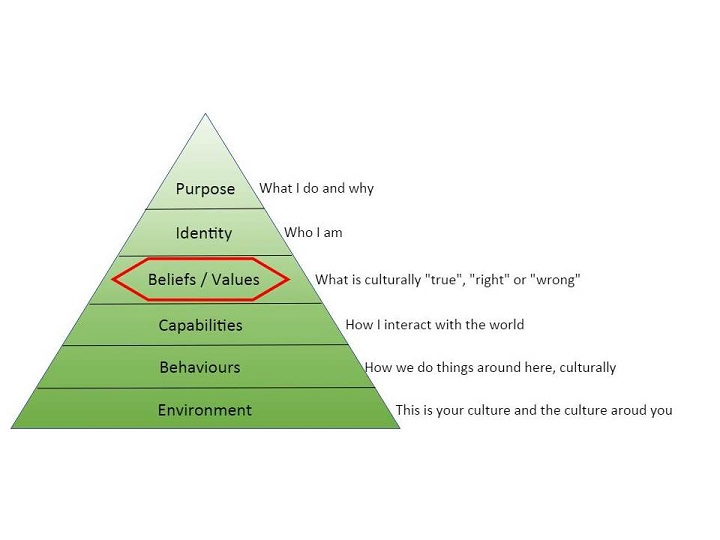
Your beliefs and values profoundly affect how you react to different cultures

In this series of posts, I am introducing how culture relates to the neurological levels that make each and every one of us.

We have seen about your environment and your and others behaviours. These two levels are the external manifestations of culture. The next level we investigated, your capabilities, demonstrates how well or not you understand, adapt and deal with various cultures.

As we go higher up on the pyramid, we begin to touch deeper, hence less obvious, aspects of culture. It is often assumed that those are individual characteristics. Here, I will argue these aspects are also driven by your culture.

The next level I will introduce in this post is about your values and beliefs. Values are what you have come to consider right or wrong. Beliefs are what we hold as true or false, whether it is or not. There is nothing objective in beliefs and values. They are arbitrarily decided. They are, once again, what we have learned and picked up from other people when growing up. We have also come up with some of our own from our experience.

Your beliefs and values will have huge effects on your success in a different culture. Imagine for a moment that one of your values is that your own culture is superior or inferior to others. How do you think it will impact you when you get to a different culture? If you believe you cannot learn a foreign language, how do you think your interactions will fare in a different country?

The good thing about beliefs and values being arbitrary is that we can decide to change them if they are unhelpful, if they impair us. If you treat cultures as different and not superior or inferior, you will develop a more curious and open mind towards the new culture you live in now. If you believe you can learn a foreign language, you very probably will!

And the ability to understand and adapt your beliefs and values will be crucial to navigate cultural diversity. Beliefs and values are the filters through which we interpret the lower levels of behaviours, environment and capabilities. It is these filters that then create the feelings we have when confronted with a new environment.

Imagine you come from a culture that values seniority and experience; you have been promoted, as everyone else, based on your seniority. Suddenly you are in a culture valuing recent achievements more than seniority. You will probably feel you may not get the respect you deserve according to your own values. This will leave you irritated, annoyed and will not be conducive to successful interactions with your colleagues, bosses and subordinates.

In contrast, reviewing, understanding and adapting your values and beliefs when necessary will allow changing in turn your capabilities, behaviours and environment.

Votre capacité à interagir déterminera le succès de votre séjour dans une culture différente.

Le principal problème est que nous ne sommes généralement pas conscients de la façon dont nous interagissons avec le monde qui nous entoure.

Dans mon dernier article, vous avez appris comment les différences de comportements, l’écart entre vos comportements et ceux des autres créeront un choc culturel avec tous les sentiments négatifs que ce choc pourrait apporter. Vos capacités sont dans quelle mesure vous comprenez ou non pourquoi vous vous comportez comme vous le faites et pourquoi les autres se comportent aussi comme ils le font.

Vous avez appris à vous comporter d’une certaine manière dès votre plus jeune âge. C’était complètement inconscient, juste en regardant les gens autour de vous et sans en avoir conscience, en copiant leurs comportements et attitudes. Avec le temps, tous ces comportements que vous avez acquis sont devenus la norme, ce qui est approprié ou juste. Vous faites la plupart de ces choses sans réfléchir. C’est tellement ancré que ça fait partie de vous-même. Et c’est une bonne chose: vous ne voulez pas avoir à penser à chaque fois quel est le comportement ou la réponse approprié.

Cependant, lorsque vous changez d’environnement culturel, que vous déménagez dans un autre pays, tous les scripts que vous avez appris et que vous connaissez par cœur sont soudainement inutiles. Vous ne comprenez pas les comportements des gens et ils ne peuvent pas comprendre les vôtres.

Votre capacité à comprendre ce qui motive vos comportements et ceux des autres et comment vous en tenez compte pour vous adapter au nouvel environnement culturel dans lequel vous vous trouvez déterminera le succès ou non de votre expérience dans cet environnement.

Vous avez probablement été choisi pour un séjour expatrié parce que vous réussissez professionnellement. Il est normal de penser que vous pouvez utiliser dans ce nouvel environnement ce qui a fait votre succès jusqu’à présent. Malheureusement, cela ne fonctionnera probablement pas. Pour réussir dans ce nouvel environnement, vous devez savoir quelles sont vos propres règles culturelles, comment elles peuvent en fait freiner votre succès maintenant. Vous devez également comprendre quelles sont les règles attendues dans votre nouvel environnement culturel.

La prochaine étape sera alors cruciale. La compréhension ne suffit pas. Pour réussir, vous devez être en mesure de changer, de défier vos propres règles. C’est la partie difficile. C’est là qu’un coach spécialisé dans la diversité culturelle pourra vous aider. Un coach vous aidera à comprendre vos préférences culturelles, les préférences de votre nouvel environnement et à trouver des stratégies et des solutions pour adapter vos préférences afin d’interagir avec succès.

Une fois que vous serez en mesure d’y parvenir, vous aurez augmenté vos capacités. Cette connaissance accrue aura alors des effets sur les niveaux inférieurs de la pyramide des niveaux neurologiques et vous manifesterez des comportements plus en phase avec votre environnement, des comportements qui apporteront les résultats que vous recherchez.

Élargir vos compétences culturelles, vos capacités est une grande amélioration. Cependant, il est nécessaire de lier ces capacités au niveau suivant de la pyramide et de comprendre comment vos valeurs et vos croyances vous aident ou vous entravent. C’est ce que nous couvrirons dans le prochain article.

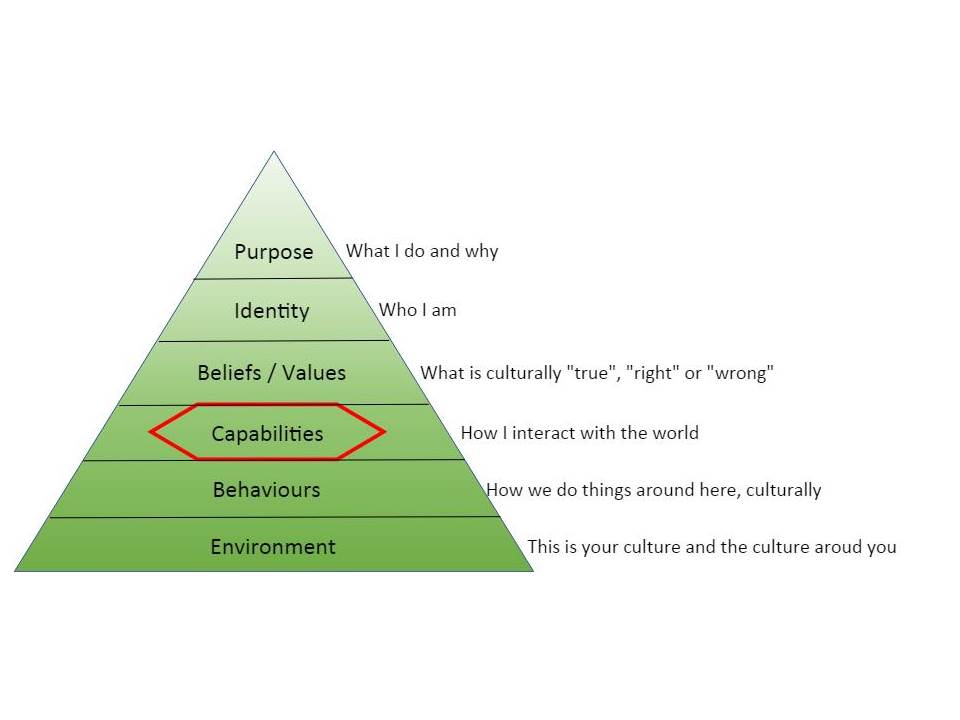
Your capability to interact will determine the success of your stay in a different culture.

The main problem is that we are usually not conscious of how we interact with the world around us.

In my last post you have learned how differences in behaviours, the gap between your and others’ behaviours will create a culture shock with all the negative feelings this shock might bring. Your capabilities are how well or not you understand why you behave the way you do and why others behave also the way they do.

You have learned to behave a certain way from your most tender age. You did it completely unconsciously, just by watching people around you and without awareness of it, by copying. With time all these behaviours you acquired became the norm, what is appropriate or right. You do most of these things without thinking. It is so engrained that it becomes a part of yourself. And it is a good thing: you don’t want to have to think every time what the appropriate behaviour, answer is.

However, when you change cultural environment, move to a different country, all the scripts you have learned and know by heart are suddenly useless. You do not understand people’s behaviours and they can’t make sense of yours.

How able you are to understand what drives your behaviours, others’ and how you take this into account to adapt to the new cultural environment you are in will determine the success or not of your experience in this environment.

You probably have been sent for an assignment in a different place because you are successful, a high-flyer. It is normal to think that you can use in this new environment what has made you successful until now. Unfortunately, it probably will not work. To be successful in this new environment, you need to know what are your own cultural rules, how they may actually be unhelpful now. You also need to understand what the expected rules are in your new cultural environment.

The next step then will be the crucial one. Understanding is not enough on its own. To be successful you need to be able to change, to challenge your own current rules. This is the difficult part. It is where a coach specialising in cultural diversity will be able to help. A coach will help you to understand your cultural preferences, the preferences in your new environment and find strategies and solutions to adapt your preferences to interact successfully.

Once you are able to achieve this, you will have increased your capabilities. This increased knowledge will trickle down the neurological levels pyramid and you will exhibit behaviours more in tune with your environment, behaviours which bring the results you are looking for.

Expanding your cultural skills, capabilities is a big improvement. However, to make it more powerful, it is necessary to link these capabilities to the next level in the pyramid and understand how your values and beliefs are helping you or hindering you. This is what we will cover in the next post.

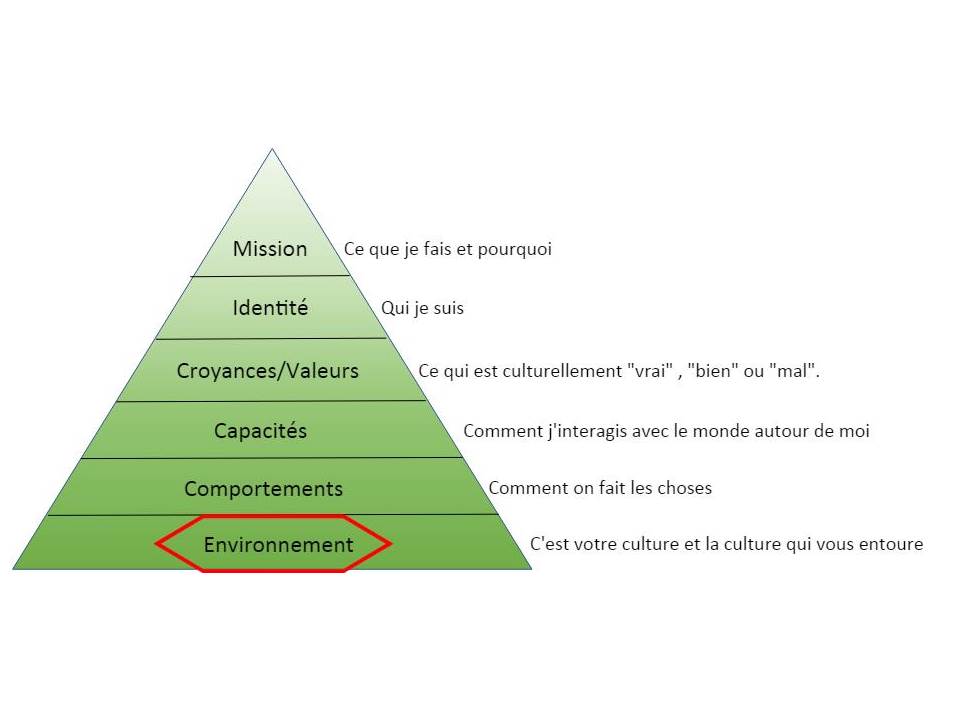
L'impact de votre environnement culturel

Le niveau le plus bas des niveaux neurologiques est votre environnement. C’est normalement votre environnement physique, la façon dont les choses sont, leur apparence, les odeurs, etc.

Mais c’est également valable dans le contexte de l’environnement culturel. C’est votre attente sur comment les choses autour de vous doivent ressembler dans cet environnementi. Et c’est plus profond que vous ne le pensez. Par exemple, je suis française et j’y ai passé les 25 premières années de ma vie. Quand je regarde des photos sans savoir où elles ont été prises, il y a généralement quelque chose qui me dit “je pense que c’est une photo prise en France”. Il y a quelque chose, généralement intangible, qui me donne la clé. C’est un sentiment, un instinct plutôt que quelque chose de concret sur l’image (sauf bien sûr s’il s’agit d’une image d’un monument emblématique.). Plus souvent que non, j’ai raison. C’est parce que j’ai construit une image de ce à quoi la France doit ressembler.

L’environnement culturel dans ce contexte doit également inclure votre environnement social. Ici, c’est tout ce que vous avez appris au fil des ans, consciemment et inconsciemment, de votre famille, vos amis, des enseignants et de tous les groupes auxquels vous appartenez. Cela se traduira dans des niveaux neurologiques plus élevés de comportements, de capacités et ainsi de suite, et je parlerai de ceux-ci dans des articles ultérieurs.

Lorsque vous allez dans un nouvel endroit, l’environnement physique est la première chose que vous remarquerez et ressentirez. Vous voyez immédiatement si un endroit a l’air pauvre ou riche, propre ou avec des détritus dans les rues, etc. Ensuite, vous commencez à remarquer un peu plus: comment les maisons sont conçues, comment l’espace est pensé et utilisé. Il y a aussi des choses qui ne sont pas liées à l’environnement créé par l’homme qui vous affecteront. Je me souviens avoir remarqué à quel point la lumière était différente de tout autre endroit où j’étais allé dès mon arrivée en Australie quand j’y suis allée en vacances. C’est dans cet environnement physique que de nombreuses différences se manifesteront de manière la plus évidente. Vous n’avez pas besoin de vivre dans un endroit lointain. Cela peut être aussi simple que de passer d’un bureau partagé à votre propre bureau dans un nouvel emploi, ou vice versa.

L’environnement est le premier niveau sur lequel vous pouvez vous sentir confus, surpris lorsque vous découvrez à quel point les choses sont différentes. Au début, le sentiment principal est plus une surprise amusée mais comme vous trouvez de plus en plus de nouveautés dans votre nouvel environnement, cela peut vous intimider et vous devenez plus négatif, vous retirant parfois en vous et devenant déprimé.

Un coach en diversité culturelle peut vous aider à comprendre votre nouvel environnement pour que vous y soyez plus à l’aise et que vous performiez mieux. Cependant, travailler uniquement au niveau de l’environnement ne sera pas suffisant dans la plupart des cas. Nous verrons dans les prochains articles comment un changement dans votre environnement affecte les niveaux supérieurs, les conséquences qu’il peut avoir et comment le gérer au mieux.

The impact of your cultural environment

The lowest level of the neurological levels is your environment. It is normally taken as your physical environment, how things are, look, smell and so on.

It is also valid in the context of cultural environment. It is how things are expected to be, to look like here. And it is more of a feature than you might think. For instance I am French and spent the fIrst 25 years of my life there. When I look at pictures without knowing where they have been taken, there is usually something that will tell me “I think it is a picture taken in France.” There is something, usually intangible, that gives me the clue. It is more a feeling, an instinct rather than something concrete on the picture (except of course if it is a picture of an iconic landmark.). More often than not, I am right. It is because I have built a picture of what France looks like.

The cultural environment in this context also needs to include your social environment. Here, it is all what you have learned over the years, consciously and unconsciously, from your family, friends, teachers and all the groups you belong to. This will translate into the higher levels of Behaviours, Capabilities and so on and I’ll touch on those in later posts.

When you go to a new place, the physical environment is the first thing you will notice and experience. You see immediately if a place looks poor or rich, clean or with rubbish in the streets and so on. Then you begin to notice a bit more: how houses are designed, how space is thought of and used. There are also things not linked to human created environment that will affect you. I remember noticing how different to any other places I had been to the light was as soon as I arrived in Australia when I went. The environment will be where a lot of the differences will show most obviously. You don’t need to go live in a faraway place. It could be as simple as going from a shared office to your own office in a new job, or vice versa.

It is the first level on which you may feel confused, surprised as you discover how different things are. At the beginning, the main feeling is more of amused surprise but as you find and consciously notice more and more novel thngs in your new environment, it may daunt on you and you become more negative, sometimes retiring into yourself and becoming depressed.

A coach in cultural diversity can help you understand your new environment for you to be more at ease in it and perform better. However, working only on the environment level will in most cases not be sufficient. We will see in the next posts how a change in your environment impacts the levels above it, the consequences it can have and how best to handle it.