This is a quote that appears on the homepage of my website. I was really proud when Joanna gave this feedback to me in writing as part of my gathering of regular feedback to improve my practice. However, I was really overwhelmed when after our coaching agreement ended, she came one day with a big bunch of flowers and a very lovely hand-made card to thank me for I did with her during the coaching. It was hard not to cry at this idea that I made a difference that was so appreciated. Being a coach is special!
I have been through many changes in my life, both personal and professional. I have lived and worked in five countries in America and Europe. When I first moved country, it took a long time before I stopped wishing every day I could just go back “home”.
I changed career too. I began as a biologist. When I reflect on it, it was associated with my profound love of nature, as a way of understanding nature better. I obviously wanted to know a lot as I went on to getting a PhD. After 15 years in biology, I switched to project management. As usual for me, I learned a lot about it and ended up a qualified project and programme manager.
It is during this career change that I discovered coaching and experienced its power to bring about change. I realised that coaching was in tune with all my values, amongst them respect, trust and honesty and that it was how I wanted to interact with people. Since then, I have been developing my coaching, getting qualified, practising and developing as a person as I had never done before. I did this up to the point where I was ready to launch my own coaching business.
With coaching, I am now aware of who I am, what I want and how to get it. I want to bring all this to you too.
Gérer votre
temps correctement est beaucoup plus que simplement rayer les taches de votre
liste plus rapidement. Prendre en charge votre temps va améliorer toute votre
vie et votre bien-être. Cela semble alléchant, n’est-ce pas ?
Dans cet
article, je vais vous expliquer comment vous pouvez accomplir cela en cinq
étapes.
Si vous voulez
en savoir plus, consultez mon site à https://coaching-vision.com où
une brochure gratuite vous donnera plus d’informations, contactez-moi à nadege@coaching-vision.com
ou prenez rendez-vous pour une discussion gratuite sur ma page Facebook.
Vous devez savoir ce que vous faites
maintenant.
Vous ne pouvez
pas changer ce que vous faites sans avoir une idée précise de ce que vous
faites maintenant. Souvent, nous avons conscience que nous avons gâché notre
temps mais nous ne pouvons pas dire où et comment. La première étape est de
comprendre comment et sur quoi vous passez votre temps. Vous devez avoir un
sens de ce que vous faites chaque jour, tout ce que vous faites et combien de
temps vous passez sur chaque activité.
Ecrivez
tout ce que vous avez à faire et organiser ces activités.
Nous avons
tous une longue liste de choses à faire, ou devrais-je écrire listes ?
Toutes ces choses sont éparpillées dans des emails, des textes, différents
fichiers et listes, dans des agendas, entassées dans des tiroirs, et de manière
plus importante, dans nos têtes. Vous devez rendre toutes ces choses visibles
et les avoir toutes ensembles. Sans une vue complète de toutes les activités à
accomplir, vous ne pourrez pas les organiser de manière efficace.
Qu’est-ce
que vous voulez faire ?
Le but de tout
cela est de faire ce que voulez vraiment faire : ce qui est juste pour
vous, et non pas ce que vous devez faire. Mais qu’est-ce que vous voulez
vraiment ? Quel serait votre journée idéale ? Qu’est-ce que vous
feriez, où, avec qui ?
Maintenant,
comment aller d’où vous êtes maintenant à où vous voulez être ?
Créez
de nouvelles habitudes.
Pour changer,
vous avez besoin de nouvelles habitudes claires et précises, pour remplacer les
habitudes que vous suivez actuellement. Ces nouvelles habitudes doivent être
accompagnées de stratégies pour savoir quoi faire si ça ne marche pas (Ca ne va
pas marcher à chaque fois, c’est normal). Cela vous évitera de retomber dans
votre ancienne habitude.
Les nouvelles
habitudes les plus faciles à mettre en place sont de faire plus ce que vous
faites et que vous aimez faire. Cela est plus facile que de mettre en place
quelque chose de complètement nouveau. La seconde chose est d’arrêter de faire
ce que vous pouvez arrêter dès maintenant. Enfin, vous pouvez commencer à
ajouter les nouvelles choses que vous voulez faire.
Action
Finalement, il
est temps d’agir. Faites la liste de toutes les actions que vous devez
accomplir dans les étapes décrites dans la section précédente. Qu’avez-vous
besoin de faire ? Quand ? Quelles sont les ressources dont vous aurez
besoin ? Quels sont les obstacles potentiels ? Comment allez-vous
franchir ces obstacles ?
Maintenant,
prenez la première action et accomplissez là. Vous êtes en charge de votre vie,
personne d’autre.
Five steps towards what you want to be doing in life
Managing your time properly is more than ticking off things
from your to-do list faster; it will improve your whole life and well-being.
Sounds a nice prospect, doesn’t it?
In this article I will explain how you can achieve this in five steps. Are you ready? If you want to know more, request a free brochure on the free resource page of this website.
Know what you are doing
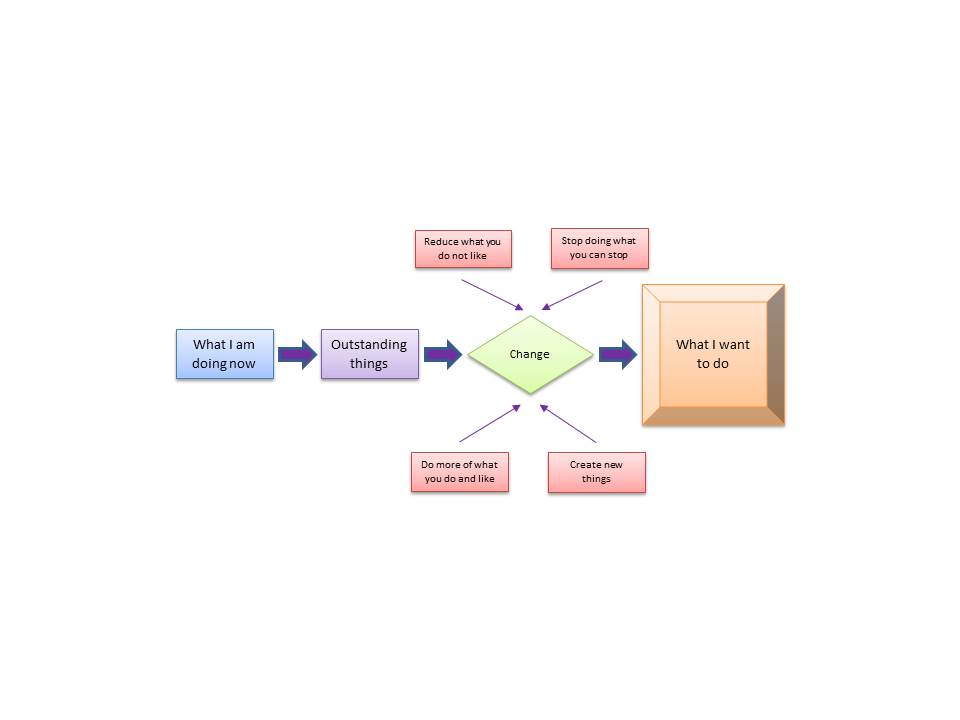
You cannot change if you do not know what it is you need to change. A lot of the time, we know we have wasted time but we are not aware of where and how it has gone. The first step is to understand how and on what you spend your time now. You need to have a sense of what you do each day, everything you do and how long you spend on each activity.
Dump on paper anything outstanding & organise
Most of us have a long list of outstanding things, or should
I say lists? All these outstanding tasks are scattered in emails, other
messages, various files and platforms, in diaries, in drawers and most
importantly in our heads. You need to have all these tasks in one place and visible.
Without a knowledge of everything you need to fit in your schedule, you will
not achieve the right balance of activities in your days.
What do you want to be doing?
Ultimately, you want to do what is right for you, not
what you “should”, “ought to”, “have to” or “must” do. But what is it you want
to do? What would be your ideal day? What would you be doing, where, with whom?
Now, how are you going from here to there?
Create new habits for change
To change you need clear and precise new habits,
activities that will replace the ones you want to stop doing. Importantly,
these new habits come with a fail-safe strategy to know what to do the times
you actually do not follow your new habit. This will happen, it is normal and
the fail-safe strategy will prevent you just falling back doing the “old same”.
The easiest new habit is in fact to do more of what you
already do and enjoy doing. This is stretching something existing rather than
inventing and putting in place something fully new. So begin with this.
In the same spirit, the second step is to design
strategies to reduce the time you spend on things you do not like doing.
Then, you are in a good place to completely stop doing what
you do not want to do and can stop doing and replace the time gained with the
new things you really want to be doing.
Action
Finally, it is time to act. List all the specific, unique
actions you need to take to implement the previous steps described. What do you
need to do? By when? What resources do you need? What obstacles could be in
your way? How are you going to overcome these obstacles?
Now, take the first action to carry out and do it. You are
in control of your life; you are the only one to make it happen.



 coaching-vision.com