Simple Ways to Involve Others in Your Projects

This article was originally published at: https://medium.com/@nadegeminois/simple-ways-to-involve-others-in-your-projects-492a2fe56c11

Running a small business can feel lonely — especially when you’re managing a project.

You might think: “It’s quicker to do it myself.” And sometimes that’s true.

But many projects work better — and feel lighter — when you involve others. Even just a little.

You don’t need a big team. You just need a smart way to bring the right help at the right time.

Here’s how to do it simply and effectively.

1. Ask: What actually needs to be done?

List the core steps of your project. Then ask: “Which parts truly need me — and which could someone else help with?”

This isn’t about dumping work. It’s about using your time wisely — and giving others the chance to contribute.

2. Start small

You don’t need to outsource the whole project.

Try delegating just one task — a graphic, a piece of writing, a round of testing. It builds trust and momentum.

3. Be clear and kind

When involving others, clarity is everything:

  • What’s the task?
  • When is it due?
  • What does success look like?

Add a little appreciation — “Thanks so much, this is a big help” — and you’ll set the tone for great collaboration.

4. Share progress visibly

Whether it’s a shared doc, a Trello board, or a group message, make sure everyone can see what’s happening.

It avoids confusion, keeps energy up, and builds shared ownership.

5. Stay in the loop — without micro-managing

Check in regularly, not constantly.

A weekly update or short message is usually enough to keep things moving and show you care.

Involving others isn’t about losing control — it’s about extending your reach.

And when you invite people into your project — even in small ways — you create more space, more progress, and more connection.

What to Do When a Project Starts to Drift

This article was originally published at: https://medium.com/@nadegeminois/what-to-do-when-a-project-starts-to-drift-54ca415a5f1e

You started with clarity. You had a plan. But now… it’s all gone a bit fuzzy.

Maybe deadlines have slipped. Maybe priorities have shifted. Maybe the energy just isn’t there anymore.

Welcome to the project drift — something every business owner faces at some point.

It’s that quiet moment when a project doesn’t fail loudly… it just stops moving.

The good news? You can get it back on track — calmly, simply, and without starting from scratch.

Here’s how.

1. Pause and take stock

Don’t panic. Just stop and look at where things actually stand.

Ask yourself:

  • What have we done so far?
  • What’s still left?
  • What’s blocking us?

Write it down. See it clearly. That step alone often reduces stress.

2. Reconnect with the goal

Why did you start this project in the first place?

Often, the drift happens because we lose sight of the “why.” Reconnect with the original intention — and ask if it still holds.

If the goal has changed, that’s okay. Adjust accordingly. If it still matters, let it refuel your motivation.

3. Break it into a smaller next step

Momentum comes from action — not from waiting until everything is perfectly aligned.

Pick one thing you can do this week to move it forward.

Not “finish the whole launch.” Just “write the headline.” Just “email the collaborator.” Just “open the file.”

Small steps create movement. Movement creates momentum.

4. Tell someone (even just yourself)

Projects drift in silence. Speaking them out loud — to a colleague, a friend, or your own journal — gives them weight again.

Try saying: “I paused this because ___, and now I’m picking it back up by doing ___.”

That small declaration can shift your mindset.

5. Create a fresh check-in habit

Once a week, spend 10–15 minutes reviewing where you are.

  • What moved forward?
  • What’s next?
  • What’s still unclear?

It doesn’t need to be fancy — just consistent.

The truth is, project drift is normal. What matters is whether you notice it — and what you do next.

So if something’s been sitting half-done, here’s your cue:

You don’t have to restart it. Just reconnect with it.

Pick one step. Do that.

Then take the next one.

How to Choose the Right Project Tools for your Small Business (Without Getting Overwhelmed)

This article was originally published at: https://medium.com/@nadegeminois/how-to-choose-the-right-project-tools-for-your-small-business-without-getting-overwhelmed-1d60236d1861

Choosing tools for your projects can quickly turn into a rabbit hole. There are hundreds of apps, platforms, and templates promising to organise your life.

But if you’re a small business owner, here’s the truth:

The best tools are the ones you’ll actually use.

Not the fanciest. Not the most feature-packed. Just the ones that match your working style and actually help move things forward.

So how do you choose?

Here’s a simple approach:

Start with your habits.

Do you like writing things down on paper? Great — use a notebook and coloured pens. Prefer dragging cards on a screen? Try Trello. Live inside your calendar? Use it as your task list too.

Keep it simple.

You don’t need five tools when one will do. Many small business owners use:

  • Google Docs (for notes and plans)
  • Trello or Notion (for task tracking)
  • Google Calendar (for scheduling)
  • WhatsApp or email (for communication)

That’s enough for most projects.

Test, don’t overthink.

Pick one tool. Use it for a week. If it helps, stick with it. If not, try another. Don’t spend hours comparing options — your time is better spent doing the work.

Avoid the “too many tools” trap.

Every tool you add creates friction. Make sure each one has a clear purpose — and that everyone involved knows how to use it.

Remember: tools are there to support your process, not define it.

Start small. Stay consistent. Build from there.

Why Most Small Businesses Overcomplicate Project Management (And How to Stop)

This article was originally published at: https://medium.com/@nadegeminois/why-most-small-businesses-overcomplicate-project-management-and-how-to-stop-53d8cb6f4cf5

If you’re a small business owner, chances are you’ve run into this trap: you try to “do project management properly” and end up with colour-coded spreadsheets, five different software tools, and a weekly planning session that feels more like a boardroom meeting than actual work.

Sound familiar?

The truth is, most small businesses overcomplicate project management because they’re trying to mimic what big companies do — without needing it. What works in a 200-person department often falls apart in a team of two. Or one.

Here’s the thing: project management, at its core, is simply about getting things done in a focused, structured way. That’s it. It’s not about jargon or templates or expensive software. It’s about clarity. Focus. Momentum.

So why does it get so messy?

Because we believe more tools = more control. Or that the “real” way to run a project involves a Gantt chart, a kick-off meeting, and maybe even a project charter.

But in a small business, you need just enough structure to move forward — not so much that you’re managing the process more than the project.

So how do you simplify?

  1. Start with the outcome. What are you trying to achieve? Be clear and specific. “Increase newsletter signups by 200 in 4 weeks” is far better than “grow the mailing list.”
  2. Break it into steps. What’s the first thing you need to do? Then the next? Then the next? That’s your roadmap — no fancy templates needed.
  3. Track the work visibly. A sticky-note wall, a simple Trello board, or even a notebook page will do. Just make sure you can see what’s happening.
  4. Review once a week. What’s done? What’s stuck? What’s next? That’s your check-in. No need for status meetings and reports.
  5. Adjust as you go. If something isn’t working, change it. You’re allowed to do that. In fact, you should.

The magic isn’t in being rigid — it’s in being responsive. That’s what small businesses are brilliant at.

You don’t need to manage your projects like a multinational corporation. You just need to keep them moving in a way that fits how you actually work.

Strip it back. Focus on momentum. Use tools that make things easier, not harder.

That’s how you stop overcomplicating things — and start getting more done with less stress.

Balancing Competition and Collaboration: Insights for Project Managers

As project managers, we’re often reminded of the importance of being team players. It’s a staple in job interviews and a key criterion in job descriptions. But how does this ideal hold up in the real world of project management?

The answer varies across cultures. In some, teamwork is genuinely valued, while in others, it might be more of a façade.

The cultural stance on teamwork often hinges on how goals and results are perceived. We all have a competitive side — evident in the popularity of sports, lotteries, and games. In certain cultures, this competitive nature dominates interactions. Negotiations often have clear winners and losers, and the concept of a win-win situation can be elusive. Rewards tend to be individual rather than team-based, and blame is often directed at individuals.

This competitive approach can have downsides: feelings of failure, loss of self-confidence for the “losers,” and inflated egos for the “winners.” It can also stifle productivity and creativity within teams. However, competition can push individuals to achieve more than they thought possible.

Conversely, some cultures prioritise collaboration. Here, people work together to achieve goals, and rewards are shared at the team level. No individual is singled out for praise or blame. Collaboration can boost productivity and innovation and lead to more successful negotiations. These cultures focus on group well-being, harmony, and nurturing everyone, not just the “winners.”

While collaboration sounds positive, it has its challenges. It can increase social pressure and lead to burnout if not managed carefully. Group decision-making often means more meetings and communication, which can be time-consuming.

Neither approach is inherently better. Each has its advantages and drawbacks. As project managers, when you find yourself in a team with different cultural norms, adaptation is key. If you’re competitive, you might need to adjust to a lack of individual recognition. If you’re collaborative, you may need to embrace personal recognition in a competitive environment.

Adapting to a new culture often involves reassessing your values and assumptions. It’s a challenging process, but essential for success in diverse team settings. Understanding these dynamics can help project managers build more effective and harmonious teams, ultimately leading to successful project delivery.

Navigating Hierarchies in Project Management: A Guide for Project Managers

This article was originally published at: https://medium.com/@nadegeminois/understanding-fairness-in-project-management-54e6932eb9de

Understanding and adapting to different organisational hierarchies is crucial.

Some organisations operate with a well-defined hierarchy, where decision-making is the prerogative of those at the top. In such environments, respect is often tied to social status, connections, age, and gender. Leaders in these settings are expected to shoulder responsibilities that support their teams, while also commanding the respect they believe is due.

Conversely, there are organisations with flatter hierarchies, where equality is emphasised. Here, decisions are made collectively, and everyone in the group participates in the decision-making process. Status is earned through recent achievements, and individuals are encouraged to take initiative and delegate tasks freely.

The contrast between these two organisational structures is often stark. In more egalitarian organisations, management tends to be more diverse compared to their hierarchical counterparts.

Regardless of personal preference for hierarchy or equality, project managers must adapt to the prevailing culture of the organisation they are working with, unless they possess the authority to instigate change.

Adapting behaviourally to different hierarchies is not inherently difficult, but personal preferences are deeply rooted in values and beliefs. For instance, those who favour clear hierarchies may express respect through deference, while those who value equality may demonstrate respect through collaboration and inclusivity.

Having worked across various countries and organisations, I understand the importance of aligning with local expectations, whether as a leader or a team member. Acting in an egalitarian manner in a hierarchical setting may be perceived as indecisiveness, while seeking to participate in decision-making without invitation in a hierarchical environment may be seen as overstepping boundaries.

Open discussions can help clarify expectations, but changing ingrained views on hierarchy takes time. However, it is not an insurmountable challenge. Many leaders who once adhered to authoritarian styles have learned to embrace inclusivity, recognising the benefits of incorporating diverse ideas from their teams.

In project management, the ability to navigate and adapt to different hierarchical structures is a valuable skill that can lead to more effective collaboration and project success.

Understanding Fairness in Project Management

This article was originally published at: https://medium.com/@nadegeminois/understanding-fairness-in-project-management-54e6932eb9de

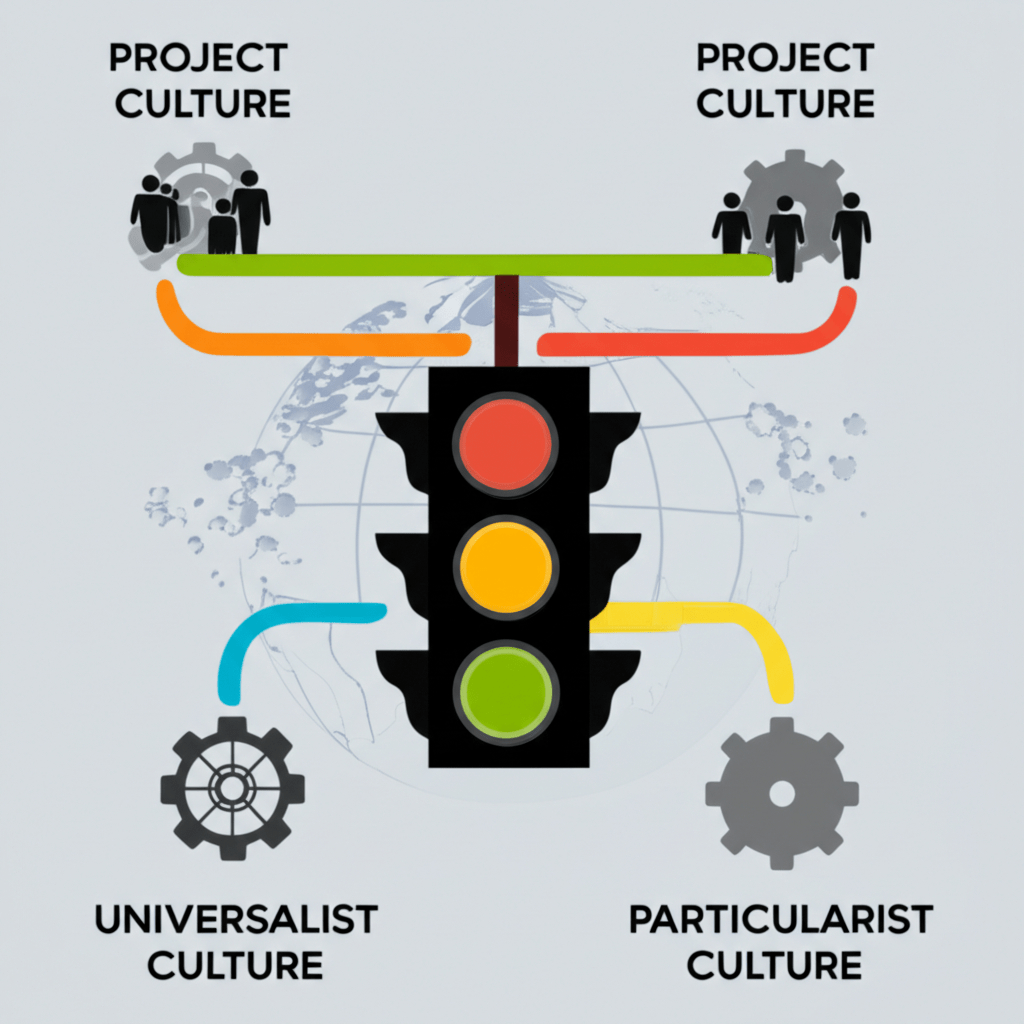
In project management, understanding the cultural nuances of fairness can be pivotal. All societies and cultures have their own set of rules and laws, but the adherence to these can vary significantly.

On one hand, we have universalist cultures, where rules and laws are applied uniformly to everyone. This “one size fits all” approach is straightforward and predictable. On the other hand, particularist cultures adapt the application of rules based on the context of the situation, allowing for flexibility and discretion.

Both approaches aim for fairness, yet the definition of fairness itself varies. In many Western cultures, fairness is often equated with treating everyone the same. However, in other cultures, fairness is seen as context-dependent, where the circumstances dictate the application of rules.

Consider this scenario often used to explore personal and cultural values: Imagine a close friend or family member has broken the law, resulting in harm to someone else, and you are the main witness. Would you uphold the law, potentially leading to punishment for your friend or family member, or would you stand by them? Would your decision change based on the specifics of the situation?

This distinction between universalist and particularist cultures can have significant implications in business, especially for project managers working in multinational environments. For instance, a company might develop a successful employee reward system in one location and decide to implement it globally. However, this approach will only succeed if all locations share the same concept of fairness. Otherwise, the system might be perceived as unfair and could even backfire in offices where cultural norms differ.

So, how can project managers navigate these cultural differences, especially when working in a new country or with a diverse team? First, assess your own cultural preferences. Then, evaluate where your colleagues or stakeholders fall on the universalist-particularist spectrum. Observe whether rules and policies are prominently followed or not. Like waiting for the green light to cross the street. These observations can provide insights into the cultural context.

If there is a gap between your preferences and those of others, adapting your behaviour and actions to align with local expectations is crucial. This can be challenging, as cultural norms often influence our perceptions of right and wrong, good and bad. It’s essential to set aside personal judgments and understand that these concepts are relative rather than absolute.

Understanding Time in Project Management: Past, Present, and Future Insights

This article was originally published at: https://medium.com/@nadegeminois/understanding-time-in-project-management-past-present-and-future-insights-4ca48b923b68

Understanding the cultural influences on our perception of time can be pivotal. Different cultures have unique relationships with the past, present, and future, which can significantly impact project dynamics and stakeholder interactions.

Cultures that value tradition often look to the past to inform present and future actions. In contrast, cultures that prioritise innovation may focus more on future possibilities, with less emphasis on historical precedents.

As project managers, it’s crucial to recognise that only the present truly exists. The past is a collection of memories, and the future is yet to unfold. However, our actions in the present are shaped by our past experiences and our expectations for the future.

To understand your own time perspective, consider a simple exercise: envision the past, present, and future as circles. How do these circles relate to one another? Are they of equal size? Do they overlap or stand apart? This visualisation can reveal how your perception of time influences your decision-making and project management style.

Our relationship with time affects our present actions, decision-making processes, and overall outlook on life. Past experiences shape who we are today, but they don’t have to dictate who we will become. The key lies in balancing our connection to the past with our aspirations for the future.

In project management, the challenge of delayed gratification is ever-present. We often struggle to envision long-term outcomes, which is why setting milestones and celebrating small successes is essential. This approach helps maintain motivation and focus on long-term goals.

Understanding how individuals and cultures relate to time can be complex. To avoid misunderstandings, observe organisational cues. Does the organisation emphasise its historical reputation, current customer service, or future innovation? These insights can guide your approach.

When interacting with individuals, exercise caution. If you are future-oriented, be mindful not to dismiss those who value past experiences or view the future with uncertainty. Embrace openness and curiosity, and share your perspective to foster mutual understanding.

In the diverse world of project management, appreciating cultural time perspectives can enhance communication, build stronger relationships, and ultimately lead to more successful project outcomes.

Time Management Across Cultures: Strategies for Project Managers

This article was originally published at: https://medium.com/@nadegeminois/time-management-across-cultures-strategies-for-project-managers-93b9714025ec

Navigating cultural differences in time perception can be a complex challenge.

Imagine this scenario: a team member arrives 10 minutes late to a crucial meeting. Fifteen minutes into the discussion, she takes a phone call. Her colleague interrupts twice with pressing questions, and now she needs to step out to address another matter. With only 15 minutes remaining, the core agenda remains untouched, leaving you wondering how to proceed.

How would you react in this situation? Would you find it exasperating or simply part of the norm? Your response might depend significantly on your cultural understanding of time.

There are two primary cultural approaches to time: monochronic and polychronic.

In monochronic cultures, time is viewed as a series of tasks to be completed in a linear sequence. Time is about doing. Meetings are expected to start punctually, adhere strictly to the agenda, and participants are focused on the task at hand. Tardiness is typically met with apologies, as time is seen as finite and linear. Cultures such as North America, Northern Europe, and some parts of Asia exemplify this structured and disciplined view of time. In these cultures, time is a resource to be managed carefully, and any deviation from the schedule can be seen as a disruption.

On the other hand, polychronic cultures, such as those found in South America, the Middle East, and Southern Europe, perceive time more fluidly. Here, time is about what you’re doing at the moment rather than adhering strictly to schedules. Priorities shift based on what is deemed important at the time, and time is a tool for building and nurturing relationships. It’s not about multitasking per se, but rather a flexible approach to switching between tasks. What might be seen as distractions in monochronic cultures are simply part of the natural flow in polychronic settings. In these cultures, the emphasis is on human interaction and the quality of relationships, rather than rigid adherence to timeframes.

So, as a project manager, how do you navigate these cultural differences in time perception? Understanding and respecting these cultural nuances is crucial. It involves being adaptable and finding a balance between maintaining project timelines and accommodating the cultural practices of your team members. By fostering open communication and setting clear expectations, you can bridge the gap between different time perceptions and ensure successful project delivery. Embracing cultural diversity in time management can lead to more harmonious and effective teamwork, ultimately driving project success.

Understanding Time Perception in Project Management: A Cultural Perspective

This article was originally published at: https://medium.com/@nadegeminois/9da920da08ca

In project management, time is often viewed as a critical resource. However, how we perceive and relate to time is deeply influenced by cultural norms, which can significantly impact how we plan our days and manage relationships with stakeholders. As project managers, understanding these cultural differences in time perception can enhance our ability to navigate complex projects and foster smoother interactions with diverse teams.

The Cultural Lens on Time

Have you ever found yourself frustrated when meetings start late, deviate from the agenda, or run over time? Do missed intermediate deadlines and milestones cause you stress? It’s important to recognise that these behaviours, while potentially disruptive in some contexts, may be perfectly normal and even expected in others.

There are two predominant cultural perspectives on time: linear and cyclical. Understanding these can help project managers better align their strategies with the cultural expectations of their teams and stakeholders.

Linear Time Perception

In many Western cultures, time is perceived as a linear process. It is seen as a finite resource that moves in one direction—forward. This perspective emphasises efficiency and productivity, with time being something that can be “spent,” “saved,” or “wasted.” The language we use reflects this view, with phrases like “time flies” or “running out of time” being commonplace.

For project managers operating within this framework, time management is often about creating and adhering to schedules, setting clear deadlines, and minimising procrastination. Tools like to-do lists and Gantt charts are staples in this approach, helping to ensure that tasks are completed in a timely manner. This perspective aligns with the structured methodologies often employed in project management, such as Waterfall or PRINCE2, where timelines and milestones are clearly defined.

Cyclical Time Perception

Conversely, in many Asian and Middle Eastern cultures, time is viewed as cyclical. Here, time is seen as abundant rather than scarce. This perspective encourages individuals to take their time, focusing on the present moment and the quality of interactions rather than the quantity of tasks completed. Relationships and being present for others take precedence over strict adherence to schedules.

For project managers working with teams that hold this view, flexibility and adaptability become key. The focus shifts from rigid timelines to fostering strong relationships and ensuring that team members feel valued and heard. Agile methodologies, which emphasise more collaboration and adaptability, can be particularly effective in these environments.

Bridging the Gap

Neither perspective on time is inherently superior; they are simply different. However, when these differences are not acknowledged, they can lead to misunderstandings and frustration. For instance, a project manager with a linear view of time may feel exasperated by a team member who appears unhurried and unconcerned with deadlines. Conversely, a team member with a cyclical view may perceive a linear-focused manager as overly demanding or inflexible.

As project managers, it is crucial to recognise where you and your team members fall on this spectrum. By understanding these cultural nuances, you can better tailor your communication and management style to accommodate different time perceptions. This might involve incorporating more flexibility into your project plans or placing greater emphasis on relationship-building activities.

Conclusion

In project management, cultural awareness is a powerful tool. By understanding and respecting different perceptions of time, project managers can create more inclusive and effective environments. This not only enhances project outcomes but also strengthens the relationships that are vital to long-term success. So, next time you find yourself in a cross-cultural project setting, take a moment to consider how time is perceived and use this insight to bridge gaps and build stronger, more cohesive teams.